It All Starts At Why

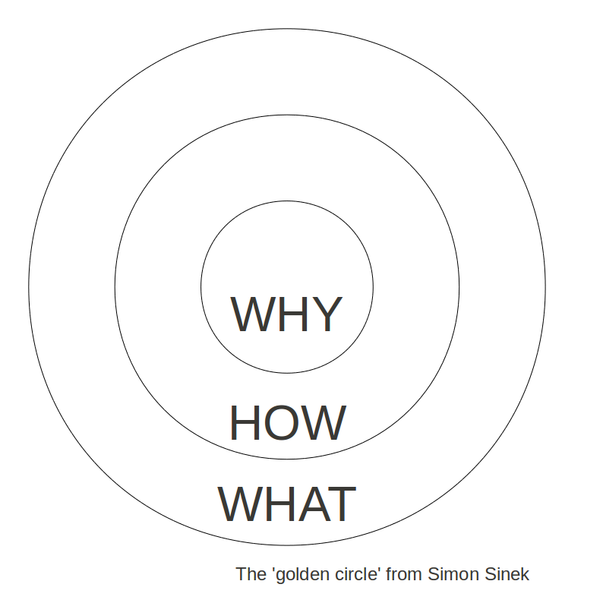
"It's not what you do, its why you do it." - Simon Sinek
At first view, the quote might might sound like something I scraped from a motivational poster.
You know the kind.
The san-serifed words would sit at the bottom of an image of child reaching for a book or a crew shell gliding through the water. The glossy posters wrap lunchrooms throughout the country.
However, after you watch this TEDx talk by Simon Sinek (embedded below), the quote carries much more meaning. While the video is worth its 18min run-time, Sinek's comments boil down to this:
- People are driven at very basics levels of thought by values
- People flock to organizations that espouse their values and beliefs
- Organizations that uphold a value that moves people, can succeed
Or even shorter, It's not what a person or organization does, its why they do it that matters.
From building software to running a political campaign (think "Change"), values are what inspire people, not the "stuff" of life. While many times we start by talking about "what" we do, it might better serve us to start with "why".
To put my money where my mouth is, let me take a look at my LinkedIn profile (feel free to add me to your network).
Instead of saying:
"I am endurance runner, digital marketer and blogger. I want to inspire people to build businesses, live healthier lives and help others."
Maybe I should switch it around (and add a little value-ness) so it reads:
"I want to inspire people to test their limits. I hope to encourage others to build businesses, live healthier lives and help others. I help do this by blogging, running and working in marketing,"
[youtube="http://www.youtube.com/watch?v=u4ZoJKF_VuA"]
The Effortlessness of the Uberathlete
Do you find running, cycling or swimming hard?
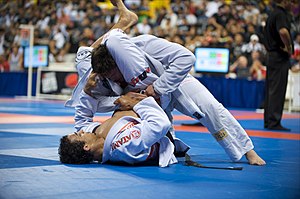
I don't know if I fullly agree with this quote, but you might find Danaher's comments interesting. A New Zealand-born Brazilian Jiu Jitsu expert, John Danaher is a teacher at the Renzo Gracie Academy and has trained many MMA champions including George St. Pierre and Matt Serra. In addition to being a champion mixed martial marts practitioner, John also holds a Masters Degree in Philosophy from Columbia University.
"The single definitive feature of the uberathlete is a sense of effortlessness in a world where most men grunt and strive and scream. It comes easy to the best, and what creates that? I think it's a sense of play. No fear or anxiety about their performance." -John Danaher, MMA trainer
For me, endurance sports are not effortless. Every push on the pedal, lap in the pool or mile on the trail takes determination. This may simply mean that I may not be an uberathlete. However, I've spoken with plenty of champions after races who limp on swollen feet and pant, trying to catch their breath. Some have even admitted anxiety at the start line because of the competition or course. This does not take away from their uber-ness.
I think what defines a great athlete is the internal balance one finds when he or she is in the middle of a competition or adventure. For me, I love the feeling of peace and quiet when your legs and lungs are pushing you forward and your muscles are pumping like an engine. You're in your element, you're exactly where you should be.
Adventures on the Trail

Google "Running" and your search results will include thousands of photos of people pounding down city streets and jogging along county roads. However, this is only part of the joy of the sport. Beyond the manicured tracks and paved roads are miles of dusty, rocky and rooted trails calling your name. While you might not get a marathon PR on the steep ascents and rugged terrain, trail running guarantees an adventure.
And that's just what I got this past Saturday.
Waking at 2:30am, I met up with three friends and headed to Leavenworth to run the Enchantment Lakes Trail. This 20 mile loop includes over 5,000ft of elevation gain, technical descents and some of the prettiest sights in the Northwest.
Because the trail starts and ends at two different locations, we first parked a car at the Icicle Creek parking lot, then drove a second car around to the Colchuck Lake trailhead. The sun was now fully out. After a quick pre-run photo, our group took off on the 20 mile trail.
The first four miles of the trial included steep inclines, but the path was wide and easy to navigate. A total joy. We stopped for photos at a few stream crossings, and snapped some jumping shots when we got to Colchuck lake.
Running on trails is all about variety, with scenery and terrain changing by the moment. The Enchantments delivered in every way.
As I carved up the trail, I used different parts of my feet, varying the strain on my muscles. The path continually changed between rock and soil, offering a refreshing break from the homogeneity of a paved road.
Six miles in, we walked and hiked Asgard Pass, a monstrous climb that reaches 7,700ft in just over a half mile. At the top, our group put on long sleeve shirts to fend off the cold alpine air. Pockets of snow clung to the sharp spires of rock around us. Goats were everywhere, the weather was perfect and the beauty of the upper Enchantment Lakes was unwavering.

After a few more photos and a quick snack, we took off again at a steady run. I was happy to be in such a beautiful place, but also looked forward to heading down to a lower (and warmer) elevation.
The hardest part of the trail run wasn't the climbing, but the descents. At around 14 miles, the trail narrows and weaves back and forth, adjacent to a stream that connects a chain of lakes. The roots and rocks make it impossible to run, while the steep descent and my momentum made slowing down even harder.
I stumbled a few times, but luckily never wiped out completely (or at least no one saw).
After a lunch break (and brief 5 minute nap) at Lower Snow Lake, our group finished the run down the hot and unending switchbacks by Icicle Creek.
In total, the run took us about 7 1/2 hours. It was an adventure capped with pizza and beer in Leavenworth. A perfect day. Details of our Enchantments run can be found here.
This was a long trail running adventure. If you have time, I highly suggest it. However, you can also enjoy shorter trail adventures at most parks including Carkeek, Discovery or Interlaken. Oh, and below is a video I made of Saturday's adventure. I hope you enjoy it.
What Are You Passionate About?

I loved my time at the TEDx Seattle conference so much, I recently applied for entry into TEDx Rainier, an independently organized TED conference coming up on 10/10/10 (don't know TED? Click here). As part of the application process, you have to answer two questions. What are you passionate about in life, your work and your community? Why would you like to attend TEDx Rainier?
Both are great questions, however the first one really intrigued me. What [am I] passionate about? I've included my response below.
What are you passionate about in life, your work, and your community? My passion in life is to inspire people to build businesses, live healthier and help others. I spend my time working to advance these goals.
As an early learning professional, I help children succeed in kindergarten. I also sit on the board of the nonprofit Powerful Schools, and am a member of the Seattle LGBT Commission. These activities interest me because I believe a literate and empowered community can create businesses that benefit society.
My other passion is running ultramarathons—races beyond the 26.2 mile distance. These endurance trail races test my patience and physical ability. Running also offers a wonderful sense of freedom.
When I am not pursuing my other passions, I blog and create brief films about these adventures—all with the aim of inspiring others to challenge their definition of possible. In doing so, I hope to encourage more people to help others in need.
###
In modern times, we should probably ask ourselves this question more often than we do. A quick, but genuine gut check on "are you going what you're passionate about" might also be helpful.
As Bueller says "Life moves pretty fast. If you don't stop and look around once in a while, you could miss it."
I totally agree.
Running Across the USA

Running 60 miles (2 1/2 marathons) in a single day is an amazing feat, a testament to the ability of the human body and mind, and something very few people in the world can accomplish.
Now try to run that day after day, over mountains, past deserts, across plains and through towns big and small.
Impossible, right?
Well, John Wallace, a runner and West Seattle resident is attempting to break the Guinness World Record for crossing the USA by foot. To do this, he will have to run over 60 miles a day, every day, for 45 consecutive days. John will start this journey on October 10, 2010.
Beyond amazing!
A lifelong runner who has put in miles every day for the past 7,578 days (and counting), John began planning this record-challenging run after his accounting position with a local sports company was dissolved. This may have been a blessing in disguise, as several years ago while on another epic run from West Port, WA to Savanah, GA, John learned about the Guinness Record for crossing the US.
This planted a dream of challenging the record, but with work and other obligations, John was kept from taking on this challenge. Now, luckily, he was free.
Over the past six months John has planned the logistics necessary for this epic run: what to eat, what to wear and how to get from the official starting point, Los Angeles City Hall to the finish, City Hall in New York City-- a whopping 2,900 miles away.
When will he sleep?
While John plans to get some shut-eye each night in his support van parked on the side of the road, the self-proclaimed night owl admits to resting while running.
"[During training] I've run with one eye closed. I don't recommend it in high traffic areas" John said with a laugh.
And of course, in order to take the record, John will have to complete this adventure in less than 46 days, 8 hours and 36 minutes, the current record. Set by Frank Giannino of New York in 1980, this amazing trans-continental record has stood for over 30 years.
Helping him along the way will be John's father who will be driving a support van over 4,000 miles during the record attempt.
While breaking the USA crossing record is John's main goal, his biggest motivation will be waiting for him back in Seattle.
"I'll be away from my wife and son, so I'll be running as hard as I can to finish, to get home sooner."
You can cheer John on by "liking" his Run USA page on Facebook, and by making a donation to support the non-profits he is raising money for: Make a Wish Foundation and the National Law Enforcement Officer Memorial Fund. To make a donation or to learn more about his run, visit www.runusa2010.com.
Good luck John! When you get to NYC, be sure to say hi to my family!
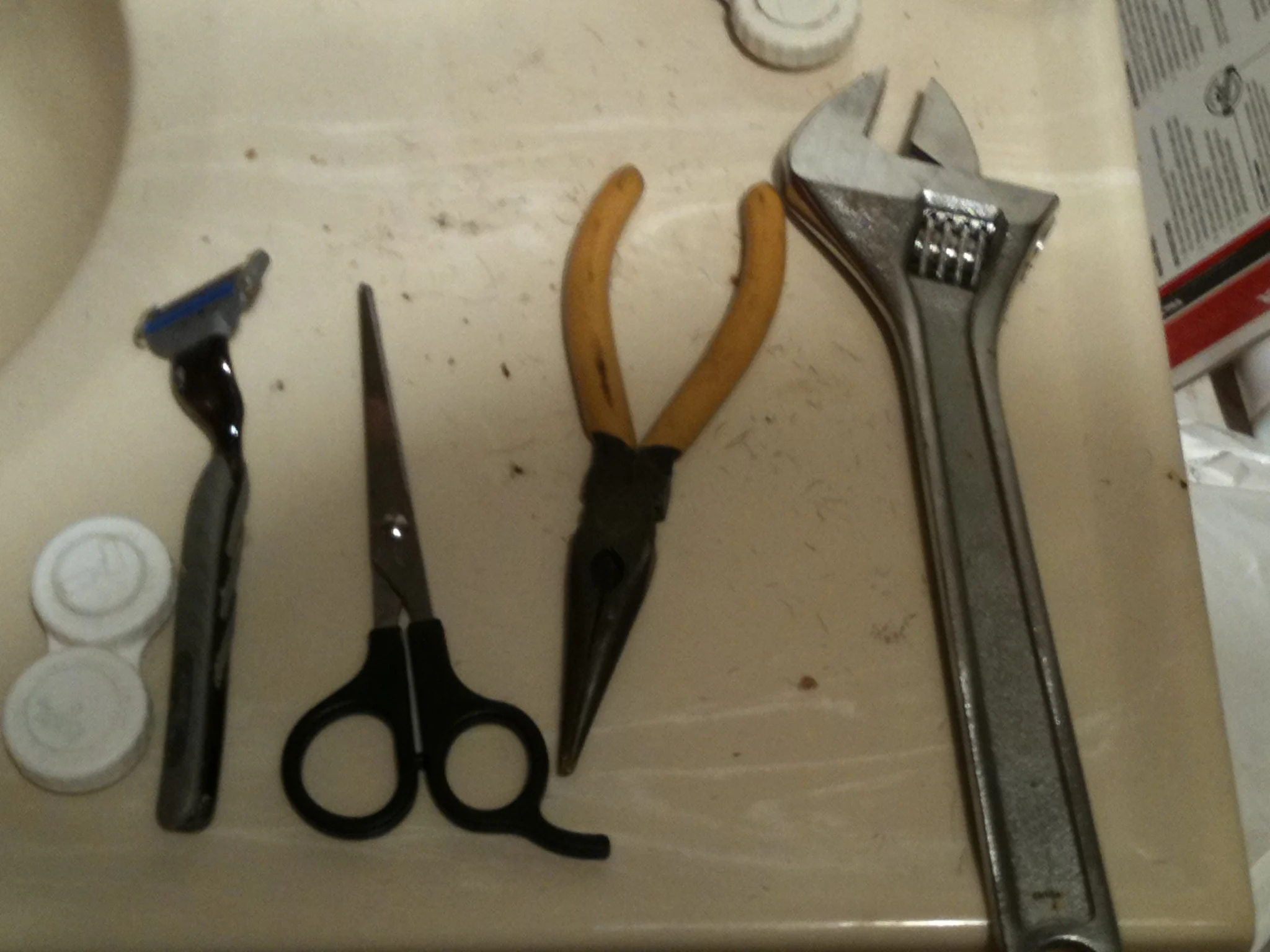
We Can Make You Pretty... By Any Means Necessary

Today I got an idea for a great ad. After cutting my hair (and missing a few spots with the buzzer), and grabbing a shower and a shave, I realized that I had to replace the bolt on my toilet. I pulled out tools from my cabinet, and after a few hours of fiddling and two trips to Home Depot, the toilet was back in place.
I glanced at my sink, and there is was. An ad for a salon (or maybe even a satire of plastic surgery).
Think of this. A hair salon that wants their customers to look their best by "any means necessary". The ad features a high contrast photo of a white sink with clumps of hair and shaving cream scattered around (low depth of field).
A progression of personal hygiene implements are laid out, with each "tool" looking more gruesome than the next. At the end of the sink (far right) are plumping and power tools. This could be a series of bus stop posters, or a video ad (voice over by the guy who does the Men's Warehousee ads).
Too much? Too scary? Does it remind you of Extreme Makeover? Let me know.

Cheating Doesn’t Work

I'd gotten away with it before, but today, at mile 22, I had nothing left.
I gave myself up.
You see, I had "cheated" on previous runs--stayed up late the night before, ate poorly, etc. Somehow I just muscled my way through 5 mile, 10 mile, and even longer runs in the past. But today I was "caught" and struggled to finish lap two of the inaugural God's Country 50k Fun Run in Anacortes.
The organizer Terry Sentinella had stayed back and tried to support me as I while stumbled through the last few miles of the second leg. But as we climbed and descended the steep hills and technical course, I knew I had nothing in me. After walking the last mile of that leg, at mile 22, I called it quits.
I hadn't twisted my ankle like on past trail runs (like on past runs), and nothing in my body specifically hurt. Instead, everything did. I felt lethargic and no amount of espresso gu's were changing that.
I wished the rest of the pack the best and sat by my car as the rest of the runners headed out to finish the last leg, the final nine miles of God's Country 50k.
How did I get myself into this? Well, it all started the night before in Seattle. My friend Jason and I met up to watch a pay-per-view mixed martial arts fight. He suggested a certain known-for-great-wings bar where we could watch the fight for free.
The fight card was great. Four dozen chicken wings and a few glasses of beer later, and Jason and I caught the 11:15 pm bus home. I knew I had to wake at 4:30 am the next morning to drive to the race, but I just assummed I'd be fine.
"I don't need that much sleep! How bad could a 'fun run' be anyway?"

And you know the rest of the story.
I learned that I can't cheat my body and I can't cheat a run.
Rest, nutrition and training are essential to finishing your practice run around town, or your next marathon. I learned this the hard way. Hopefully you won't have to.
What I learned:
- Rest Between Races -- Anywhere from a week or longer of rest is needed depending on your conditioning and the length of your competition. This means hold off from practice runs until you're 100% back. Can't stop exercising? Maybe consider some cross-training using different muscle groups. Swim, bike or simply walk.
- Get Plenty of Sleep --While some elite athletes describe skipping bed to run through the night (I'm talking ahout you Karnazes), this doesn't work for most people. The body heals itself when you're sleeping, so make sure you get your ZZZZs.
- Eat Healthy, Eat Balanced -- A balanced diet with plenty of protein, fat and carbohydrates, among other nutrients, ensures your body has the building blocks to repair and grow stronger. Note: Seek guidance from a licensed professional. I am not a nutritionist.
- Don't Stress Out -- Don't stress your body with substances like beer/liquor/wine, or major life obligations (deadlines at work/weddings, etc) right before a long run or race. Take it easy for a few days. Your body will thank you.
Got other tips for your staying strong and healthy? Add a comment below.
A long day at White River...

This past Saturday I ran my first 50 mile race, the deceptively pleasant-sounding White River 50 Mile Endurance Run. Fifty miles is far, like two marathons far, but the real challenge was the elevation gain. The White River course climbs and falls over 16,000 feet as you ascent and descend two mountains.
I had never run this far before, I mean, I rarely ever drive fifty miles. I knew this was going to be a long day.
The early starters began the race at the still-dark 5:30am. I choose to camp at the start on Crystal Mountain and lined up with a few hundred other runners for the 6:30am start of the race.
Mentally I was prepared to be on the course for the next twelve hours, meaning I'd (hopefully) cross the finish before the last of the post-race BBQ dinner was served. This was all new territory for me.
Did I have enough food? Did I need another pair of socks? Should I have made drop bags?
It was too late to worry now.
With 15 minutes before go-time, I threw off my sweatshirt, filled my hydration pack and stashed some gels in my pocket. Surprisingly, I wasn't nervous. I guess I accepted my fate and walked over to the start line to wait for instructions.
After confirming a few names on the race roster, Scott McCoubrey, the race organizer, reminded all the runners of the course rules. Then, without much fanfare, the race began. 300 pairs of feet launched down the trail. Runners included men, women, old, young, talkative and quiet.
Despite the craziness of what we were all attempting, people were happy and relaxed. Just another jog in the park... I guess.
Luckily, the weather was ideal. The cool morning hovered in the 60s, making the first few miles enjoyable. Most runners skipped sunglasses and journeyed into the woods with just a handheld water bottle and a race number pinned to their shirt.
I was less bold and took a Nathan Hydration Vest filled with 2 liters of water, a few energy Gu's , S! sodium and potassium capsules, and a few sheets of toilet paper "just in case".

As the miles ticked by, my body felt strong. The narrow single track trail made passing tricky, but most runners didn't seem to worry about jockeying for position. Instead, everyone just talked and joked as they cut up the trail.
At mile four we hit our first aid station. Runners loaded up on gels and water, then set out on a six mile climb up the first mountain.
This is where ultra-marathoning showed itself as an odd cousin of the marathon. Instead of continuing to run the steep switchback trails, many of the fit and competitive runners around me switched from a confident run to a steady hike. The quick walking steps up the switchbacks were often times faster than if someone tried to run the entire course, at least for us mortals (this rule excludes the top 20 finishers who somehow burned up and down the trails without walking).
On a training run two weeks earlier I had gotten great advice from Scott McCoubrey, the White River Race Director and founder of Seattle Running Club.
"Micromanage the course. Run the steps you can run and walk the steps you need to walk, even if just for a few feet at a time" Scott told me.
This proved to be great advice. Many competitors who pushed the pace, paid for their lack of discipline later down the trail. I just tried to stay calm and patient.
At every aid station, suffering runners were welcomed by volunteers with cheerful faces. I alternated between catching my breathe, gobbling watermelon and thanking them as the course team loaded water into my Nathan HPL.
Things were going as well as they could go until I hit mile 26, at about 5 1/2 hours. I, along with a pack of six other runners had just finished descending the first of the two major climbs. We had spend most of the time in the shade of the trees on the way down, and I was happy I didn't twist my ankle like I had on my my first ultra.
I hit up an aid station, gulped a few cups of Mountain Dew and started the long ascent on the second mountain. About a mile into the climb, my head began to feel woozy and I started to lost my strength. The trail broke out of the trees and we now were ascending switchbacks on loose dirt trails, exposed to the sun. I felt terrible and couldn't run, smile or think. Instead I just put one foot in front of the other. I had to make sure I didn't overheat, otherwise I wouldn't be able to make it to the next aid station.
"I have to get to Suntop" I thought. This was the final aid station before the descent to the finish.
My head pounded and walking just a tenth of a mile at a time felt like it took forever. Luckily, a passing runner handed me some Tylenol. I took a pull form my hydration pack, downed the pills and ate my last energy gel. I needed to get off this trail, and the only way was to keep going up.
After another 30 minutes of treking, I made it to Suntop, the last aid station before the major downhill run. Volunteers sprayed me with water and I rolled a few slices of potato in salt for a snack. I took a minute to catch my breathe, then began my run down the dusty fire road--six miles of quad-crushing descent.
As I was leaving the aid station a runner called out:
"Great, we only have a half-marathon left."
I don't think he was being sarcastic, but it wasn't the easiest thing to hear after running 37 miles.

The downhill was tough on the legs, but I made it. Dust from the road now colored my legs a dark orange.
After the last aid station of the race, I began the most technical part of the trail. The namesake of the race, the White River, ran alongside this last six miles. I'd stop to admire the beauty if I weren't so beat up. I finishing the course with a combo hobble/walk/run.
After 10h 24m, I broke out of the woods, dropped my backpack and sprinted the last 40 yards to the finish line. I made it!
It was a tough day, but the post-race BBQ quickly calmed my nerves.
Cheers to the Anton Krupicka, the winner and course record holder who finished in 6:25:29 and Meghan Arbogast, the women's champion who completed the race in 8:10:51. You can view all the results and photos at http://whiteriver50.com/.
Also, check out a video I made from the race at http://www.youtube.com/watch?v=UAYPuGDV9wI
Cascade Crest: Your First 100 Mile Race

Sara training for the CCC
Last month at the White River 50 Mile Endurance Run I met Sara Malcolm, a talented trail runner with an infectious smile. While I stressed about attempting my first 50 mile race, Sara looked strangely calm and collected.
After chatting for a minute, I found out why.
White River was just a "training" run for Sarah. She was preparing for the Cascade Crest 100 Mile Endurance Run, her first 100 mile race.
Cascade Crest (or CCC, as the veterans call it), is a brutal 100 mile race along the Pacific Crest Trail that begins this Saturday, August 28th.
The course includes over 20,000ft of elevation gain and requires runners to strap on head lamps as they run through the night, often finishing well into Sunday.
Recently, I met with Sara to learn more about her training, goals and fears as she attempts her first 100 mile ultramarathon.
[Q & A with Sara Malcolm]
How did you get into running? [SM] Well, I think I ran my first race when I was in 3rd grade (it was a 1/2 mile I believe), but I didn't really start running consistently until I was probably 18. I started running to stay in shape in college and eventually began running 5ks and 10ks here and there. I ran my first half marathon in 2007 and my first full marathon in 2008 so I am still really new to long distances.
I really enjoy the longer distances for the challenges and changes in scenery that they provide. I love running a race through a new city and getting to see all of it or running trails over a couple of mountains. It's amazing to see the ground you can cover. Additionally, there is very supportive and friendly community that partakes in the marathons and ultramarathons around here.
How did you prepare for your first 100 mile race? [SM] Not enough. Ha. I did spend a lot more time on the trails this year. I tried to run on trails at least once or twice a week to get better acquainted with the terrain that I would be running on. I had an injury earlier this year so I wasn't able to ramp up my mileage like I had hoped, but I did get in some good long runs. In addition to several 20-30 mile runs, I ran two 50 mile races, a 50k, and a few marathons. I put in more consistent hill work and worked on strengthening some weak muscles. I also did a couple night runs to get more comfortable running in the dark.
Did you learn anything new preparing for this course and distance? [SM] I learned (and am still learning) the importance of fueling. It seems the longer the race, the more meticulous you need to be with your fueling (at least in my case, everyone is different).
Your body can only absorb so many calories while it's burning them, so you are in a constant state of trying to keep up. If you get too far behind you can get into a tough spot. I guess I've also learned that you just need to keep moving. It's easy to lose time and momentum by hanging around at an aid station too long.
Because of the length of the race, you will likely run a part of it at night.
How do you feel about attempting your first 100 mile race? [SM] I'm nervous, but not about the terrain and running with a headlamp, but about animals and noises in the dark. That makes me a little uneasy.
What do you think the best parts of the course will be? And the lowest? [SM] I think the PCT will be really nice. I'm also excited to take in the incredible views from No Name Ridge and Thorp Mountain, but I think this will also be one of the more challenging areas of the course. It's in the last 20 miles and there is some serious climbing... so maybe it will also be a low point. I really have no idea where the mentally rough patches will come, but I know there will be several. The plan is to just keep moving; putting one foot in front of the other.
What type of support will you have on the course? [SM] I might have a couple of drop bags, but my main support will be my crew (my husband and my dad) who will meet me at a few spots and my pacer (a friend who will run the last 50 miles with me). My mom will be there at the start/finish and probably worrying the entire time in between. I grew up in the area so some of my extended family might make it out to the finish as well.
Do you have any goals for the race? [SM] The goals are to finish under the cutoff [32 hours] and to have a good time. Since this is my first 100 miler I feel those are challenging enough, yet realistic.
Do you have any tips for people who might be thinking of registering for a century race? [SM] I volunteered at the race last year and it got me excited. The course, the volunteers, the RD [Race Director], the other runners... all amazing.
So I thought about it for a few months and got a better sense of the training it would take. On paper it seemed doable so I planned to sign up. My plans were derailed a bit when I got a stress fracture earlier this year. Depending on the recovery I still thought it might be possible. The race fills up pretty quickly so when the time came to send in my registration, despite my injured state, I just did it. I knew if I hesitated I wouldn't get in. I figured that if I just signed up I would make it happen.
However, this was all dependent on my injury, so the contingency was that I survive a couple 50 milers first. Even though I have been training for it all year, I didn't really accept that it was going to happen until I finished White River 50 last month.
If you are thinking about doing a 100 miler, try to see one in action first. I feel quite inexperienced and naive going into this one and if I had more time I would definitely volunteer and/or try to pace at more races. The more exposed you expose yourself to it, the more you learn, and the better off you are. I would also run more races in the 50 mile to 100k range. I know it is a big goal, but goals aren't supposed to be easy. I would say be realistic, but don't shy away from the challenge.
Thanks Sara for your story and tips! Good luck this Saturday. I'll be there cheering you on!
Life Goals: Inspired by the ICanHasCheezburger Guy

Back in April, I had the pleasure of attending TEDx Seattle, a great conference that included artists, researchers and scientists sharing stories about how technology and culture intersect. (If you don't already, you should subscribe to the TED podcast.)
One of my favorite speakers from the event was Ben Huh, owner of the IcanHasCheezburger Network, and associated with everything #lol, #cat and #fail. Ben shared a touching story in his presentation "19 Thinks that I Owe Myself to Accomplish". Filled with emotion, Ben talked about his first failed business and he came to build his current blog empire--all the while accomplishing life goals.
Ben had a total of 19 goals on his list. Some he had accomplished (learn to ride a motorcycle) and some he had yet to (give away a million dollars). The goals were grouped under categories: Have Fun, Help Yourself, and Help the World.
Ben's speech was so inspirational, I decided to make my own list of goals, complete with groupings.
So without further adieu, here is what I came up with.
In no particular order, this is what I want to achieve in my life.
Find My Limit
- Learn how to kickbox
- Ride a motorcycle to Alaska
- Run 100 miles without stopping
- Travel around the world
- Win an athletic competition
- Earn an award
Build a Base
- Become an expert at something
- Find the perfect woman
- Sell a company for a profit
- Raise a child
- Own a house
Help Others
- Teach at a college
- Become a blogger
- Write a book
- Teach my child how to ride a bike
- Become a public speaker
- Pay for my child's college education
So, that's what I have at the moment. There will probably be a few drafts of this.
How can they find me?

This afternoon my coworker and I struck up a conversation on how old we were getting in relation to the Internet. Jessica shared a story about how she had to convince her first two employers to include their web addresses on their marketing materials so that donors could find them (you know, way back in '02).
Two thoughts came to my mind from this discussion.
First: Wow, we're fortunate to live during a time when we can watch something as great as the Web mature. With the exception of the French Revolution, it's rare that people get to experience a technology or trend completely reorganize the way every part of society operates.
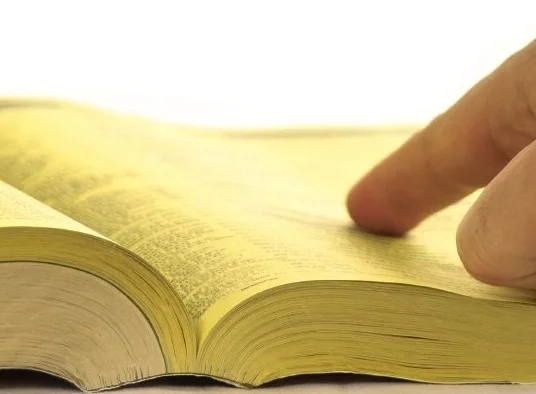
Second: People, organizations and businesses need to actively think "How can others find me?" -- a notion that would have sounded odd a few generations before when findability was baked into the social structure of a village or into the authority of a Yellow Pages phonebook.
So, what can you do now to be "findable" on an ever growing Web?
Make a big digital footprint.
- Reserve your domain name
- Register your username on popular web services
- Link to your various profiles online
And this goes for both your business and your person.
By reserving you or your brand's accounts (Mashable has a great article on this) and user names on a variety of services, you're helping to build a larger footprint online. So, when someone searches on YouTube for "Joel Ballezza", they get me instead of a "no results found" page or some giggling babies.
The same thing goes for Twitter account, Facebook and the like.
In a thoughtful way, try to build out your digital footprint so that people will know how to find you.
1,000 Miles: Interview with an Everyday Superhero
Want to challenge yourself? Forget running or biking a wimpy 26.2 mile marathon. Instead try 1,000 miles.
That's exactly what a friend Joe Tegeder recently did. Amazing. Superhuman!
And yet, Joe is just a regular... well, Joe.
He was able to achieve this significant accomplishment in just over nine months.
To put the distance in context, 1,000 miles is equal to running from Seattle to Salt Lake City, with another six more marathons tacked on. Yeah, ... like REALLY far!
I recently got to sit down with Joe to learn about his journey into fitness and to gain some tips on how an everyday guy could accomplish a superhuman feat.

Want to challenge yourself? Forget running or biking a wimpy 26.2 mile marathon.
Instead try 1,000 miles.
That's exactly what a friend Joe Tegeder recently did. Amazing. Superhuman!
And yet, Joe is just a regular... well, Joe.
He was able to achieve this significant accomplishment in just over nine months.
To put the distance in context, 1,000 miles is equal to running from Seattle to Salt Lake City, with another six more marathons tacked on. Yeah, ... like REALLY far!
I recently got to sit down with Joe to learn about his journey into fitness and to gain some tips on how an everyday guy could accomplish a superhuman feat.
[Q & A with Joe Tegeder]
Recently your cumulative running and biking over the past nine months passed 1,000 miles. What does 1,000 miles mean to you? [JT] 1000 miles is amazing to me. Keeping track of my activities has been a great way to see my progress which in itself has been a great motivator at times to keep pushing forward.
What inspired you to get into running, biking and swimming? [JT] I have been running off and on since 2000 but really started running on a consistent basis around May 2009. My inspiration came in many forms. The main one was that I moved from Mississippi to Seattle in January of 2009 weighing in around 270 lbs. I promised myself that I would make a huge lifestyle change in Seattle. As far as being more involved with triathlon and running/biking/swimming, I have wanted to do an organized triathlon for almost 20 years. I figured that it was now or never. So I bought a bike and jumped right in. When I first started it felt a little overwhelming, but after watching shows like the biggest loser and seeing the contestants twice my size running marathons, I knew it was possible. I just had to be patient and not expect results over night.
Why do you enjoy being active? [JT] I enjoy being active because the physical changes make me feel better about myself and I have gained an entirely new confidence level about myself.
Have you noticed any health changes with your increased activity? [JT] I have noticed many health changes with my increased activity. Everything is a little easier. Most obvious for me is when I go snowboarding. I am no longer out of breath strapping into the board and I can do an entie run now without stopping every few turns. Has it been difficult finding time for your training? What advice would you give a busy adult? [JT] Sure it is difficult to find time/motivation but I just try and make time. I think you just have to make it a priority. Even if it means waking up earlier to do it. Every little bit counts so just get out there and do something for 30-50 min 3 times a week. You will see a change in a few weeks, I promise.
What are you most proud about from your athletic endeavors? [JT] I am most proud that I keep setting goals for myself and achieving them.
Do you have any other tips or advice for someone who is interested in being active, but has yet to take their first step? [JT] Just get out there and do something. Realize that you are your worst enemy. When you hear yourself making an excuse just ignore it and go for a 10 or 20 min run/walk. You will find yourself actually wanting to do more.
Thanks Joe for taking time to chat. Good luck on your next 1,000!
You're an inspiration to us all.
Northwest Passage with Team Fly by Night

At just before 12:30pm last Saturday, I crossed the finish line with Team Fly by Night to complete the Ragnar Northwest Passage Relay. We were tired, sweaty, and in one case, fighting stomach issues after a recent trip to Mexico. Despite this, we completed the 168 mile relay course! And we did it in a respectable 26 1/2 hours.
It felt like much further in the past, but it was just the morning before when our team met up at the Northgate Park n' Ride in Seattle to count our gear and begin this adventure.
After making sure we had enough head lamps, reflective vests and food, 12 runners piled into a minivan and an SUV, and headed north to the relay start in Blaine, Washington.
Over the next day, teammates in each van took turns running legs of the race lasting 3-9 miles, while runners in the other van rested and ate.
Now to be honest, my squad, van 2, started our day pretty relaxed.
Because we were running second (slots 6 - 12), we first stopped in Bellingham, baked cookies at a teammate's house, napped on plush couches and watched Ferris Buelers Day Off on a 50'' TV. This was all while the other van of Fly by Night teammates hit the start line and began the run southbound in 85°F weather (guess life just isn't fair).

We killed a few hours at Kelly's house, then headed to the first exchange point for a safety briefing and warm-up run. After getting confirmation by cell phone that Joe, the last runner in van 1, was just under a mile away, we crowded the hand-off point. Kelly, our next runner, stood bouncing with energy, yearning to go.
In a blink of an eye, Joe screamed around the corner, crowds cheered and Kelly took the "baton", an organge slap bracelet labeled with the Ragnar logo.
Bam, she took off. Kelly's 5'1' frame soared down the road.
Van 1 would now get a few hours to rest and drive to the next hand-off point. Meanwhile me and Van 2 began leap frogging Kelly to make sure she had water and food, and that she stayed on course as we pushed south.
Team Fly by Night did this for the rest of Saturday and through the early hours of Sunday. Runner after runner would hop out of the van, strap on a head lamp and beat a path into the darkness. It felt like some crazy game.
I started my second leg, a downhill trek of 5.4 miles, at the groggy hour of 3:15 am. While I promised myself that I'd hold a steady and slow pace, the excitement of the night got the best of me, so I furiously chased the bobbing white and red lights in front of me (runners from other teams). My pace sped up from 9...8... then 7 min/mile as I burned downhill.

The descent was taking its toll and by the time I reached Deception Pass, my quads were numb. Finishing this leg was the only thing in my mind.
As I crossed the Deception Pass bridge, the ground was lit only by my headlamp and the full moon. This was probably a good thing. I'd be too scared to run if I could see the dark water far below the narrow bridge walkway.
Just before dawn, my van got to La Conner High School. Some of us grabbed showers, while others slep on the floor of the gymnasim. The sight of hundreds of bodies laying on the floor was surreal--a cross between a camping adventure and an emergency shelter.
After less than two hours, our team woke, dressed and prepared to receive the baton once more. Luckily everyone was healthy and energized. As we had done before, we met Van 1 and the runners exchanged the slap bracelet. The race for us was on once more... south to Langley.
At a quarter to noon on Saturday I received the last handoff just east of Rt. 525, the last 4.8 of our 168 mile relay. This leg would finish the race.
Unlike my previous routes, I had some elevation to contend with, with a big hill just before I entered town. I pushed hard and was coated in sweat as I entered Langley. Shirtless, I dodged tourists on the sidewalk and closed in on the final mile.
A few hundred feet from the finish line, my teammates Heather, Bob, Kelly, Catherine, Joe, Michele, Mike, Natasha, Ed, Molly, and Ted joined me and we finished the relay together as a team. A perfect ending.
The Ragnar Northwest Passage Relay was an amazing journey with Fly by Night. We met wonderful people, saw beautiful parts of Washington and traveled hundreds of miles by foot. Incredible.
We'll be back next year!
In the meantime, I have bigger things to worry about. Below is a video from our Northwest Passage journey.
[Youtube="http://www.youtube.com/watch?v=zIhB6GuHF2U"]
White River 50... What?

While hiking about three months ago, I met a runner at the summit of Tiger Mountain who was taking a break from looping the steep trails. Doug was decked out in a Nathan Hydration Vest, mud-covered trail runners and a pair of wrap-around shades.
He looked all business.
This sparked my curiosity, so I asked if he was training for something.
"White River" he said.
"What's that?"
"The White River 50 Mile Endurance Run. It's an ultra in July" he mentioned.
After a few minutes of chatting, Doug sipped some water and took off on a trail that crossed the rest of the Tiger peaks.
50 miles, whoa.
I had read about ultra marathons before, but never really considered what training for one looked like. Doug put a face on this, and it was a serious one.
I wondered if I could run it.
After a few weeks of grappling with the idea and reading the White River website, I got my nerve up and registered for the July 31 race.
Fast forward to last Sunday. The organizers of White River held the second of two training runs on a section of the actual course. Myself and about 25 other runners tackled 22 miles and climbed 5,000 feet, finishing in around 4 hours. It was tough, but food, water and great comradely made it bearable.
The last six miles of the run were down an old stone and dirt logging road. While we got plenty of "free speed", the constant pounding transformed my quads into jello. As I finished the last mile, I struggled to contemplate how I'd be able to do that run, plus more elevation and another 28 miles tacked on for the actual race. No time to think.
At the bottom of the hill, myself and a bunch of other runners dipped our legs in the glacier run-off to reduce swelling. After the initial shock of the near freezing temperature, the water was refreshing and helped to make the limp back to the car less painful.
Now its time to rest, heal up and pray for race day, July 26.
Below are photos and a few video clips from the training run.
[youtube=http://www.youtube.com/watch?v=YyVTiYqX-AU]

Run to Social Media
Last week I presented at the SOAR Putting the Peices Together Conference where professionals from non-profits and school districts came together to explore ways to work more effectively. I spoke on a panel discussion about online collaborative services, and learned from an attendee that Seattle Public Schools does not have any presence on social media. No connection to students and no outreach to parents.
That's right. Zero.*(See note below)

Last week I presented at the SOAR Putting the Peices Together Conference where professionals from non-profits and school districts came together to explore ways to work more effectively. I spoke on a panel discussion about online collaborative services, and learned from an attendee that Seattle Public Schools does not have any presence on social media. No connection to students and no outreach to parents.
That's right. Zero.*(See note below)
Now I know the idea of using sites like Facebook, Twitter and YouTube to engage the community is still a new practice for many organizations, but to not have ANY presence? This is a shame!
With close to 1/2 billion people on Facebook, a dialog is going on that every large (and small) organization needs to be aware of. Each night more eyes watch YouTube, than broadcast news.
At minimum, a school district should have a Facebook Page (and maybe even a Twitter account). Just in case something DOES go wrong, the school or district will have these tools to fight back, and to tell their story.
This doesn't mean that every mom and pop bakery needs to be Tweeting their daily deals (but it helps). This just means that every large organization, particularly a public school system, should be part of the dialog.
As a great teacher once told me...
Tell your story or someone else will.
What if a school doesn't have a social media presence?
Well, when a teacher commits a crime, how will you respond? What about when your district wins a national award? How will the public know?
If all the local newspapers shut down or simply just don't have room to cover all your successes (or snow delays), what tools will you have to tell your story, to spread your message?
All schools, private and public, from pre-k to post-secondary should consider using social media. From sharing parent updates, to highlighting innovative programs (Sec. Duncan recently toured Aviation High School... and they're on Twitter), this is just another tool for communicating. This is why you need a social media presence. If not for gabbing, for correcting errors and celebrating successes.
That reminds me, check me out on Twitter @joelwho
*NOTE: I checked on Facebook and discovered that the only result for Seattle Public Schools is a wikipedia page slurp that Facebook automatically generated. This is just another example of why schools need to get on board. You need to tell your story, or someone else will. Run to social media!
Running for... Heat Exhaustion

Friday, YES!
Summer was finally here, and I was excited to have my work week over.
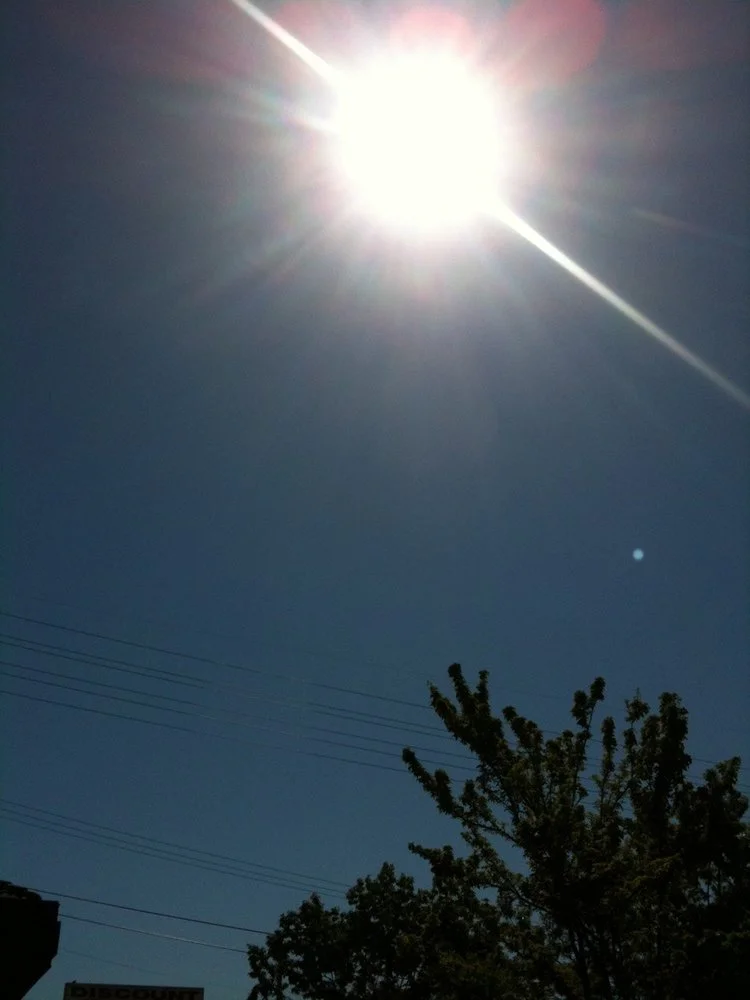
As I drove home yesterday, I contemplated which route I would run in this georgous weather. The radio said the temperature was pushing north of 90°F, intense for this region, "...but I was from the East Coast" I thought.
I can handle this!
So, I parked my car, headed into my house and put on my running gear. I decided to do a 6 mile route down and around Green Lake. I could steal some shade from trees on the sidewalk heading down to the lake and would bring my hydration vest for water.
I gulped down two glasses of juice and ate a banana.
Without thinking twice, I tightened the laces on my Brooks sneakers, and headed out the door.
BAM! The hot air hit my face and body. With each breathe, the air proved un-refreshing to my lungs. I've run this route many times before, but never in these conditions.
The sun beat down upon the pavement, heating everything 30°+ beyond normal. I started jogging and within just a few feet, sweat started trickling down my back. I took a pull of water from my hydration pack, but it too was heated by the sun through the exposed tubing.
Despite this, I was able to continue running and made it down to Green Lake.
As the downhill leveled to a flat trail, the effects of the weather started to take their toll. My head started pounding and my pace slowed.
With this slower cadence, I continued to run around Green Lake, passing sun bathers and families resting in the shade. However, with each stride, my body felt weaker. I was running, but was hurting and my stomach started to ache.
Normally, I pride myself on my stomach's robustness, but at that moment, it felt ready to lose itself. Maybe that juice and banana before the run was a bad idea?
At the same moment, my head began to pound louder than ever. I realized that I was suffering from some type of heat exhaustion and needed to cool down ASAP!
Luckily, about 200 feet ahead were the bathrooms by the Green Lake boat house. I sought refuge in the building and made a bee-line for the sinks. After pouring water onto my neck and back, and sipping water from my hydration pack, I started to gain my senses.
Whoa.
After dousing myself in water a second and third time, I walked outside and stood next to the lake. A breeze began to cool my damp body and my headache, lessened.
Running in this weather, at this intensity, was obviously a dumb call on my part. I ran too fast, and didn't listen to the signals my body was sending.
Once I cooled down and collected my senses, I finished the route, but at a much slower pace. For the last three miles I was careful to take note of my heart-rate, breathe, and perspiration, and took frequent sips of water.
My fellow blogger Kristina Moats offers some great tips on running in hot weather. I'll know better for next time.
Career Advice for a Recent Grad

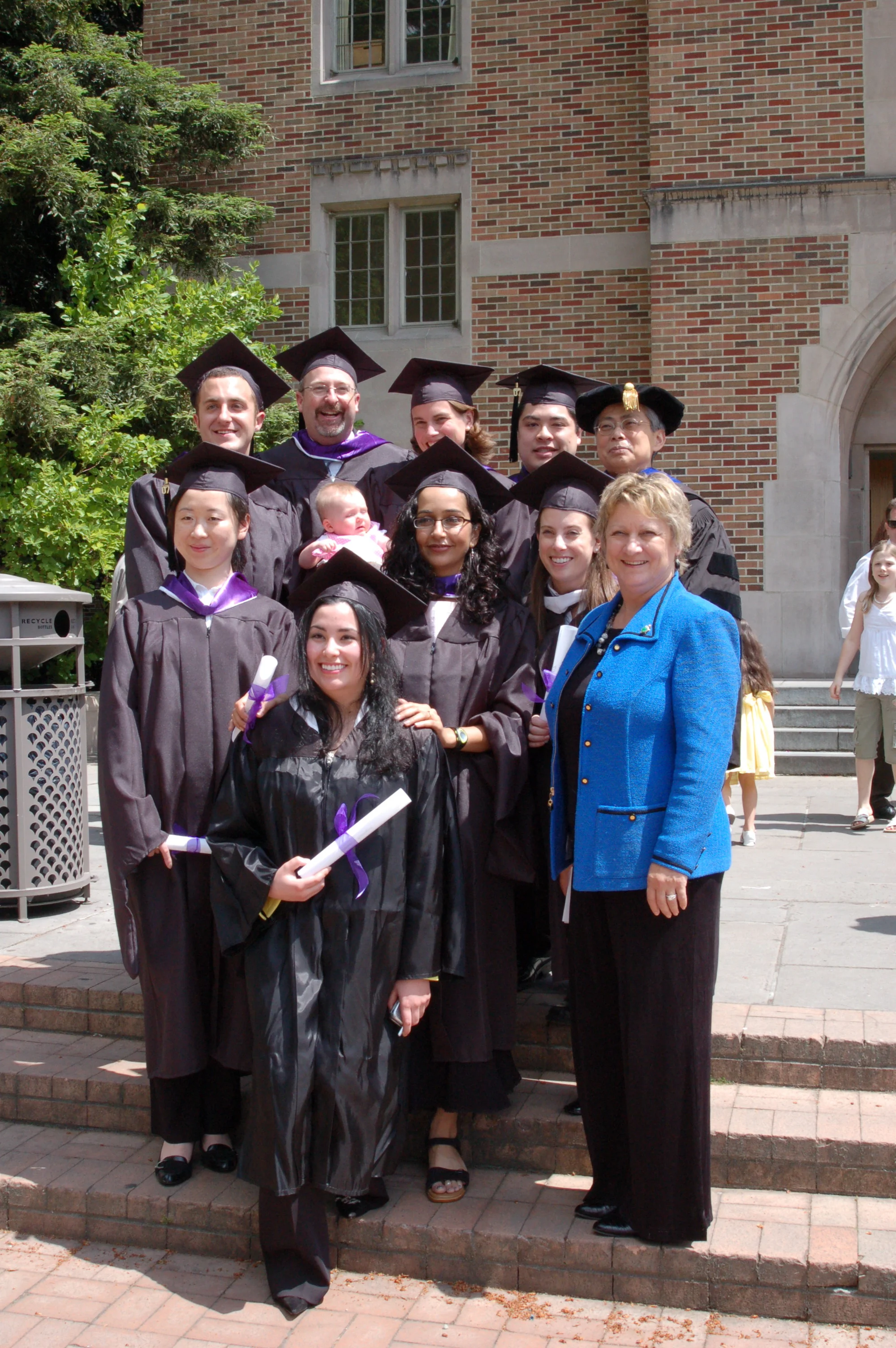
My graduate class from the M.C.D.M program at the University of Washington
A few weeks ago I met up with Emma, a recent graduate from the University of Washington. Filled with passion, this young professional was smart, but unfortunately she was starting her career in a tough economy, and entering a fiercely-competitive job market. This was my advice to her.
- Look, Listen & Learn You have awesome ideas, no doubt, but you are also young and can use this "excuse" as a tool to soak up decades of knowledge from your coworkers and parent's friends. So, just try not to be the new freaking guy and interject too often (I know this from personal experience). Instead, listen to the ideas being presented around you, try to find ways where you can contribute meaningfully, then deliver on your promises.
- Work with Your Strengths You may not have a decade of work experience, hundreds of connections in your field or a lengthy resume to support you in your job search. However, that doesn't mean you don't have a competitive edge on other professionals in the market. After four years of college, you know how to live cheaply. This means you can take a lower-paying position that a professional who is supporting a family might not be able to. Also, you probably can move around and travel easier than others in your field. Make an inventory of your skills. You might be surprised by what you come up with.
- Seek Out Opportunities to Network You probably didn't discuss this much in school, but networking is probably the single most important activity you can do to support your career. This includes getting to know your coworkers, colleagues in your field and other professionals out in the world. Seek out projects at work or in your volunteer life that expose you to a wide variety of people. You never know what will come of it --an exciting project, new job or maybe even a marriage.
- Brand Yourself "So, what do you do..." is something you might hear a lot in your life. And while the monikers "Doctor" or "Engineer" conjure up specific images of a profession, "write stuff and manage clients" is much more nebulous. Try to identify the root of your skills and work (for a simple narrative), and offer this to the next person who asks. "I am an online marketer for enterprise software." A wise man once told me "No one hires a generalist." So true!
So these were a few of the tips that I offered Emma. I know she goes far!
Stories Matter

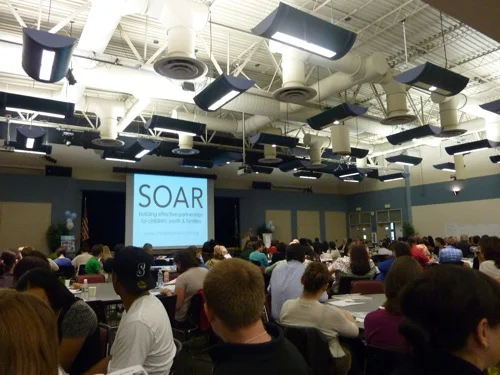
Yesterday I had the pleasure of speaking on a panel at the Putting the Pieces Together: Building Effective Partnerships for Children, Youth & Families conference, an event organized by SOAR, a coalition of organizations in King County, Washington that support children (see Panel Discussion below). The panel offered tips on how non-profits can use social media to advance their work. I highlighted how Ning.com and Facebook are effective tools for marketing an organization and connecting with parents, and offered examples of how I've used them at Foundation for Early Learning.
But that's not really what this post is about. Really, I want to share what happened AFTER my panel discussion.
The Power of Stories
After my session was up, I thanked the moderator and headed over to participate in a conference session as an attendee. After scanned the open sessions, the title "Effective School-Community Collaboration" piqued my interest. I headed for room 202.
This panel discussion included partners from a the Seattle Shakespeare Theater and Seattle Public Schools. Within just a few minutes, the presenters told a story of John, an eighth-grader in the special education program. He never spoke up in class, and was particularly shy around other students his age.
Despite this, John enrolled in the after-school Shakespeare collaboration between the theater and Seattle Public Schools. He was even brave enough to take on a role that required him to charge across the stage with a short staff (weapon) and announce the attaching group of actors in a production of Henry V.
By simply showing a photo of this boy, and sharing this quick story, the panelists were able to highlight the effectiveness of their partnership (theater helped John discovered his voice). A fairly complex idea, all communicated with just a few words and a photo. Wow.
What's my take-away from this session?
Include stories in as many places as you can. They deliver messages extremely well, and make your work come alive.
Is Running Addictive?
 Sure, drugs, alcohol and cigarettes can be addictive, but can running be, too? Hmm...
This came up on a recent walk with a friend. Carol and I looped Greenlake and she mentioned how she knows some folks in the ultra-marathon community (people who run 50, 75, 100+ miles at a time) who are recovering drug addicts.
Carol mentioned how for these extreme runners, in a sense, one addiction was given up for another. In this case, a chemical dependancy was exchanged for a runner's high (see this article in Science Daily on treating alcoholism).
Maybe running is addictive?
I mean, running, like most sports, releases Endorphins into brain. This simulates some of the same sensations that occur from narcotics (though, probably to a lesser extent).
Jogging along, one foot in front of the other for hours on end is tough. And yet, people still do it. Maybe it HAS to be addictive, otherwise the trails and streets in the NW wouldn't be as packed as they are with enthusiasts.
But that's just my thoughts on it. What do you think? Is running addictive, or is a "Runner's High" just a covert marketing ploy by the big shoe companies?
Add a comment below.
-R4C
Make 'em Talk

How do you get a quiet audience at a discussion panel to share in the interaction on stage? You take away the microphones. Let me explain.
After witnessing disastrous Q & A sessions when conference attendees were too shy to line up at microphones and ask questions for a discussion session, I realized we needed a better way to solicit questions during a live event. Our solution was to take away the microphones and to use mobile phones instead.
In preparation for Foundation for Early Learning's annual luncheon with over 600 attendees, I setup an SMS text message service using a “short-code”, a unique string of five numbers to make texting easier. In this case we used the service Mosio, but there are a number of great, low-cost services that do this.
During the 2010 Luncheon, we flashed a PowerPoint slide with the short code on the screen and encouraged the audience of 600 attendees to send their questions for the panel using their mobile phones, instead of their voice.
Our result? We received dozens of questions, and cultivated a robust discussion within the panel on stage. Best of all—no uncomfortable silence!